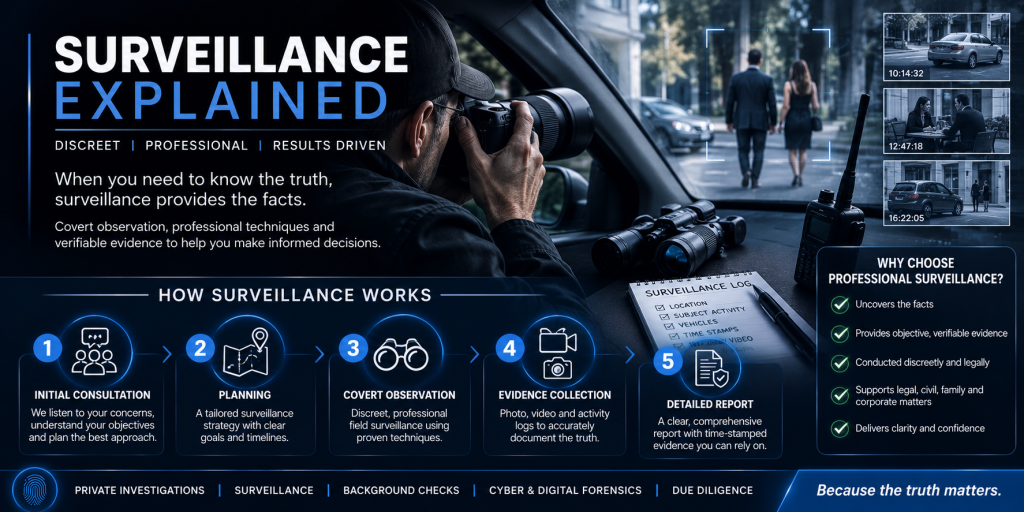
Surveillance explained: What It Is, When It’s Used and How Professional Private Investigators Conduct Surveillance
A Complete Guide to Surveillance Investigations in South Africa
Surveillance is one of the most recognised services offered by private investigators, yet it is also one of the most misunderstood. Many people associate surveillance with dramatic television scenes involving hidden cameras and high-speed pursuits. In reality, professional surveillance is a carefully planned investigative process designed to gather objective evidence while remaining lawful, ethical and discreet.
At Rick Crouch & Associates, surveillance forms an important part of many investigations involving insurance fraud, family law matters, civil litigation, workplace misconduct, corporate investigations and criminal defence enquiries.
This guide explains how surveillance works, when it is appropriate and what clients can realistically expect during a professional surveillance investigation.
What Is Surveillance?
Surveillance is the systematic observation and documentation of a person, place, vehicle or activity to establish facts and gather evidence.
The objective is not to invade someone’s privacy, but to lawfully observe behaviour or activities that are relevant to an investigation.
Professional surveillance focuses on facts rather than assumptions. It provides objective evidence that may confirm or disprove allegations, helping clients and legal professionals make informed decisions.
Why Is Surveillance Conducted?
Surveillance is often used when facts cannot be established through interviews, documentation or database research alone.
Common reasons include:
- Insurance fraud investigations
- Suspected employee misconduct
- Workers’ compensation investigations
- Child custody disputes
- Divorce investigations
- Asset verification
- Business fraud investigations
- Intellectual property theft
- Contract breaches
- Due diligence investigations
- Criminal defence investigations
- Missing person investigations
- Witness verification
Every surveillance operation begins with a clearly defined investigative objective.
How Does a Professional Surveillance Investigation Work?
Successful surveillance requires careful planning rather than simply following someone.
Before surveillance begins, investigators assess:
- The objectives of the investigation
- Known addresses
- Work locations
- Vehicle information
- Daily routines
- Risk factors
- Local environment
- Legal considerations
- Safety requirements
This planning allows investigators to maximise observation opportunities while minimising unnecessary costs.
Types of Surveillance
Professional investigators use different forms of surveillance depending on the circumstances.
Static Surveillance
Static surveillance involves monitoring a fixed location such as:
- Residential properties
- Business premises
- Warehouses
- Offices
- Parking areas
- Meeting locations
Investigators remain discreet while observing activity over a period of time.
Mobile Surveillance
Mobile surveillance involves observing a person or vehicle as they move between locations.
This may include:
- Vehicle observations
- Pedestrian surveillance
- Multiple destination monitoring
- Activity documentation
Experienced investigators constantly assess traffic conditions, safety and operational risks while maintaining legal compliance.
Corporate Surveillance
Businesses often require surveillance to investigate:
- Internal theft
- Fraud
- Time theft
- Workers’ compensation abuse
- Employee misconduct
- Intellectual property theft
- Unauthorised business activities
Corporate investigations help employers protect assets while ensuring that decisions are based on objective evidence.
Insurance Surveillance
Insurance companies frequently use surveillance to verify claims involving:
- Personal injury
- Disability claims
- Vehicle fraud
- Property damage
- Workers’ compensation
- Medical claims
Objective observations may assist insurers in assessing whether reported activities are consistent with the circumstances of a claim.
What Evidence Can Surveillance Produce?
A professional surveillance investigation may include:
- Photographs
- Video recordings
- Time-stamped observations
- Vehicle information
- Location records
- Behavioural observations
- Activity timelines
- Meeting observations
- Arrival and departure times
The evidence collected depends entirely on what is lawfully observable during the investigation.
What Surveillance Cannot Do
Professional investigators must always operate within the law.
A reputable private investigator will not:
- Enter private property without authority
- Install hidden recording devices unlawfully
- Intercept telephone conversations illegally
- Hack mobile phones or computers
- Access private bank accounts
- Obtain confidential records unlawfully
- Impersonate police officers
- Trespass into restricted areas
Clients should be cautious of anyone who promises illegal access to private information or guarantees results obtained outside the law.
Is Surveillance Legal in South Africa?
Yes, when conducted lawfully and ethically.
Private investigators must comply with applicable South African legislation, including privacy and evidence laws. Surveillance must be conducted in a manner that respects legal rights while gathering information relevant to a legitimate investigative purpose.
Professional investigators understand these legal boundaries and conduct operations accordingly.
How Long Does Surveillance Take?
Every investigation is different.
Some surveillance operations may be completed within a single day, while others require several days or longer to establish meaningful patterns of behaviour.
The duration depends on factors such as:
- Investigation objectives
- Subject activity levels
- Weather conditions
- Travel distances
- Work schedules
- Availability of observable activity
- Operational complexity
A professional investigator will recommend an appropriate surveillance schedule based on the facts of your case.
Will Surveillance Always Produce Results?
Not necessarily.
One of the biggest misconceptions is that surveillance always captures dramatic evidence.
In reality, surveillance may:
- Confirm suspected behaviour
- Disprove allegations
- Establish patterns of activity
- Identify new investigative leads
- Demonstrate that no unusual activity occurred during the observation period
Even where no significant activity is observed, that information may still be valuable in the context of an investigation.
Reporting the Findings
Following the surveillance operation, clients receive a comprehensive report that may include:
- Chronological observations
- Time logs
- Photographic evidence
- Video evidence
- Location information
- Vehicle observations
- Investigator notes
- Conclusions
Reports are prepared in a professional, objective manner and are suitable for review by clients, attorneys, insurers and other authorised parties.
Surveillance for Legal Professionals
Rick Crouch & Associates regularly provides surveillance services in support of:
- Civil litigation
- Criminal defence investigations
- Family law proceedings
- Labour disputes
- Insurance investigations
- Commercial litigation
- Corporate investigations
We work closely with attorneys, advocates and corporate legal teams to ensure investigations are aligned with the objectives of each matter.
Why Choose Rick Crouch & Associates?
When you instruct Rick Crouch & Associates, you benefit from:
- More than 30 years of investigative experience
- Licensed South African Private Investigation Agency
- Experienced surveillance investigators
- Professional evidence collection
- Nationwide investigation services
- Confidential handling of sensitive matters
- Detailed photographic and video documentation
- Clear communication throughout your investigation
- Comprehensive reporting suitable for legal and business matters
Our investigators are committed to conducting professional surveillance that is discreet, objective and legally compliant.
Frequently Asked Questions
Can someone tell if they are under surveillance?
Professional surveillance is designed to be discreet. Experienced investigators use planning, observation and appropriate operational techniques to minimise the likelihood of detection while always acting lawfully.
Is surveillance available throughout South Africa?
Yes. Rick Crouch & Associates conducts surveillance investigations throughout South Africa and can coordinate investigations across multiple provinces when required.
Will I receive updates during the investigation?
Yes. Clients receive appropriate progress updates while preserving the integrity of the investigation.
Can surveillance evidence be used in court?
Surveillance material may assist in legal proceedings. The admissibility and evidential weight of any evidence are determined by the court and the applicable rules of evidence.